
7 September 2026 · AW Prod
Cast-Iron Street Furniture: A Guide to Industrial History

By Priya Sutton
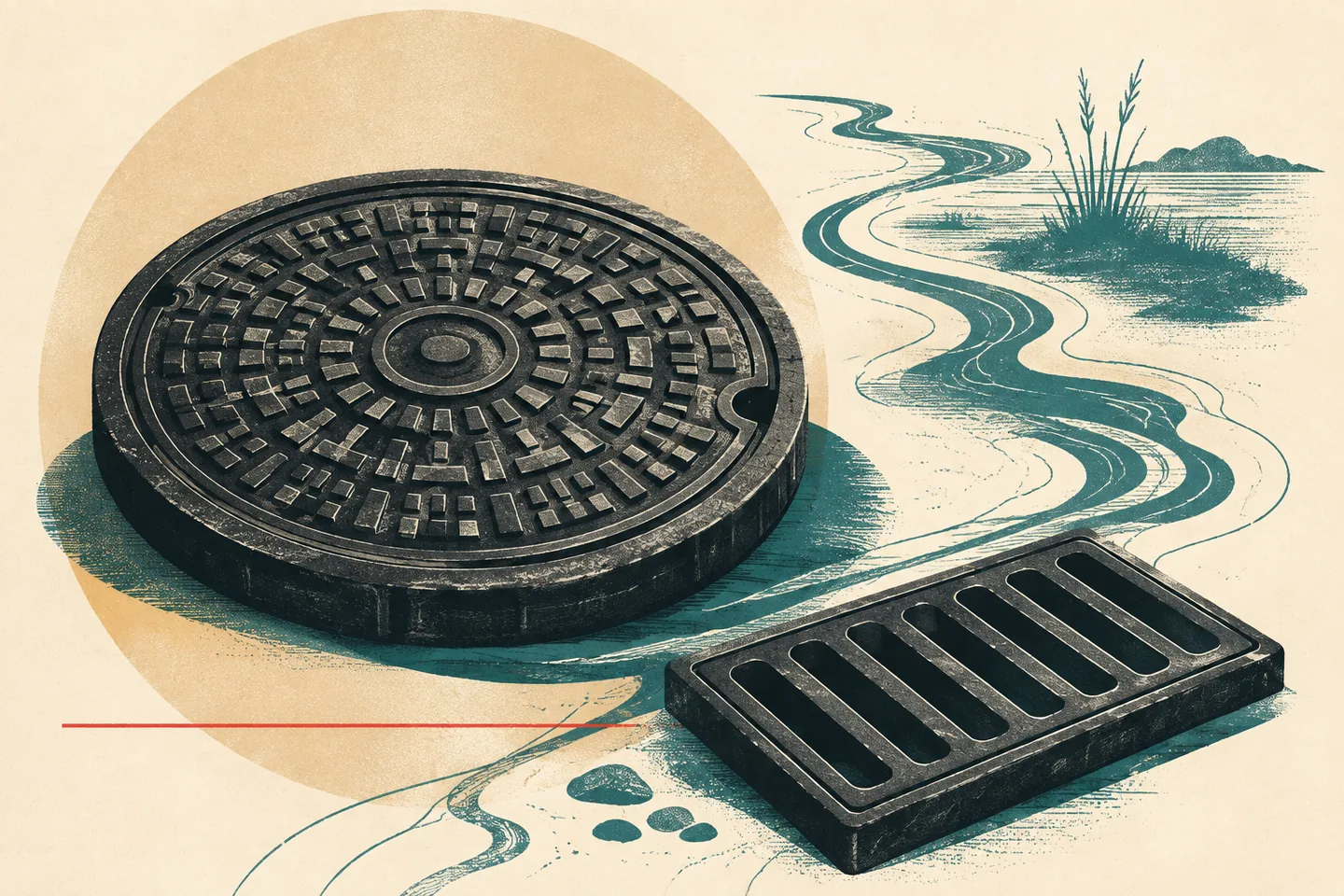
A cast-iron cover or drainage grate can be a useful starting point for understanding a street. Its lettering, shape and setting connect an everyday object with manufacturing, public works and the infrastructure beneath the pavement. Reading those clues carefully means separating what is visible from what still needs documentary evidence.
This guide explains how to investigate street castings without turning a maker’s mark into an unsupported company history. It covers their purpose, the industrial setting in which they were made, and a practical method for recording and checking an object. Historical identification and technical suitability are separate questions: evidence for one does not establish the other.
Start with the object’s purpose
An access cover closes an opening through which authorised workers can reach underground equipment or services. Its frame provides the seat and connects the assembly to the surrounding construction. A drainage grate admits surface water through openings. These functions may occur close together, but appearance alone does not establish which system lies beneath a particular casting.
Look first at the relationship between the object and its setting. A grate beside a kerb suggests a drainage function; a solid cover may provide access to a chamber. Treat that as an initial interpretation, not a confirmed identification. Labels, utility records or drawings may supply the missing evidence.
Record the cover and frame separately where both are visible. They work together, and a photograph of the central panel alone omits potentially useful details about the seating arrangement and surrounding repair work. Do not assume that all visible parts were installed at the same time.
Put manufacturing in its local setting
Foundries belong within a wider industrial landscape. They use patterns and moulds to produce metal components, serving demands that may come from agriculture, factories, buildings or public works. Transport connections, materials, workers and customers help explain why metalworking developed in a particular place.
For a regional example, the Wisconsin Historical Society’s history of Neenah provides background on a community’s development through milling and manufacturing. Use such a place history to establish context before investigating an individual casting. It offers a broader frame than the lettering on one object.
A municipal heritage overview is another starting point for examining connections between settlement, transport and industry. Keep the scale of the evidence clear: a description of a town’s industrial growth cannot, by itself, prove when a particular cover was cast or fitted.
Build the local account around questions that records can answer. Where were workshops located? Which transport routes served them? When did streets or drainage systems expand? This approach connects manufacturing with the built environment without assuming that every surviving object belongs to the same period.
Distinguish manufacture from installation
A street casting can have several relevant dates: manufacture, purchase, installation, repair and relocation. A date on nearby masonry may refer to the surrounding structure rather than the metalwork. A dated street photograph establishes that an object was present when the image was taken, provided the identification is secure.
Lettering may identify a maker, place, public authority, pattern or intended service. Transcribe it before interpreting it. Preserve line breaks and uncertain characters in your notes rather than silently completing a worn word. A familiar-looking mark is a lead to investigate, not permission to fill gaps from memory.
Historic building records can help establish a manufacturing timeline. A National Register nomination is one example of documentation that can connect buildings with industrial activity. Check which property and period each passage concerns, and record the page supporting your claim.
When dates conflict, keep them attached to their sources. An undated catalogue illustration, a later reminiscence and a contemporary purchase record carry different kinds of evidence. Do not combine them into a precise chronology unless their relationship is demonstrable.
Read shape and surface cautiously
Covers and grates combine practical requirements with visible design choices. Outline, surface pattern, lettering and openings all deserve attention, but none should be treated as a universal code. Similar designs can occur in different places or periods, while replacement parts can alter an older installation.
The University of Wisconsin’s Wisconsin 101 project offers an example of using a street object as an entry point into industrial history. An object study can guide questions about function and manufacture; it does not establish that another similar-looking casting has the same history.
Describe what a surface photograph actually shows: raised lettering, repeated ribs, worn areas, visible openings or a border pattern. Avoid diagnosing material strength, internal condition or remaining service life from those features. A historical record and an engineering assessment require different evidence.
The same caution applies to size. An apparent match in a photograph does not establish interchangeable dimensions or frame compatibility. Perspective can distort proportions, and dimensions that matter to a fitted assembly may be hidden below the visible surface.
Make a useful field record
Keep observations consistent so that another reader can identify the object and understand the limits of your account. A short, organised record is more useful than numerous close-ups with no location or date.
- Location: record the street and position using a stable nearby reference.
- Date: note when you observed the object and took photographs.
- Setting: describe the pavement, kerb, road or other surrounding surface.
- Lettering: copy visible text exactly and mark uncertain characters.
- Form: describe the outline, pattern and visible relationship to the frame.
- Images: take a context view and a detail view where safely accessible.
- Uncertainty: separate direct observations from proposed identifications.
Observe from a safe, publicly accessible position. Do not lift, move or test a cover, enter a chamber, step into traffic or obstruct a pedestrian route to obtain a photograph. If dirt or wear obscures a mark, record that limitation instead of disturbing the installation.
Check the documentary trail
Choose records according to the question. Maps and directories can help locate industrial premises. Public-works records may document street construction or purchases. Catalogues may help identify patterns. Newspapers and photographs can provide dated references, although captions and retrospective accounts still need checking.
For each useful source, save its title, date, page or image reference, and the specific point it supports. Note whether it is contemporary with the event or a later account. If several websites repeat the same statement, look for their common source rather than counting repetition as independent confirmation.
A simple research file can separate observed facts, documented facts and unresolved questions. For example, a visible place-name is an observation; a dated record of a workshop at that location is documentary evidence. Whether that workshop produced the object remains unresolved until a source connects them.
Turn notes into a concise account
Begin with the object, its location and its apparent function. Follow with the strongest documented connection to local industry or public works. Include only the wider history needed to explain that connection, and state uncertainty where it affects the interpretation.
For technical decisions, pass the question to the responsible asset owner or engineer with the location and observations. Historical identification cannot establish load suitability or replacement compatibility. For historical writing, stop where the evidence stops: a clear description with one well-supported connection is more useful than an elaborate story built around an unexplained mark.